
Clip from Animal Arms: Butterfly
Project:
Brain Breaks
Client:
Pure Edge
Agency:
Circus Picnic
Year:
2021
The Challenge:
Pure Edge had an existing series of illustrations showcasing yoga poses and basic sequences for a pre-K to early elementary age audience. The illustrations featured a number of animals (rabbit, frog, dragon). They asked me to take a selection of poses and rudimentary sequences in order to animate them so that children could follow along with them. The movement was meant to be slow, intentional and easy to follow.
While the character designs already existed, they posed a number of challenges when it came to building a system for animation. Primarily, they needed to get on model (consistent) as their proportions varied from one illustration to another. A decision was made early on to focus on the Frog character and the Dragon who had wildly different ranges of motion.
Clip of the Frog doing Mountain Chair
Clip of the Dragon doing Tree Pose
The Solution:
A fully animated approach allowed for children to more accurately follow along in the poses and sequences. The characters were cute and fun and engaged the children in ways that live action video might not. They moved more like children, without a focus on adult bodies with different proportions. The Creative Director loved how "hard it looked like they were trying." We didn't want perfection in the movement, we wanted them to be accessible and within the range of what Pre-K aged kids could do without getting frustrated because it was too challenging.
Clip from Recharge Sequence
Process and Design: Characters
The two characters were put on model, using the proportions that created the widest range of motion available for them. For the frog that meant making use of their thin, elongated limbs in a way that they could illustrate both the seated poses and the standing ones with the same puppet build. The dragon required fewer adjustments as there were fewer sequences with the dragon, so their proportions were more consistent to begin with.
Because the characters were black and white with clearly defined outlines, I approached the character builds from a new perspective. Instead of using interpolation, they were designed to be animated on 2s, with an ever expanding library of swappable assets. An arm raising would use a handful of different arms to create the arcs of the motion. This created a more natural looking movement to the flows and it allowed for patches to be used sparingly to close gaps in the outlines that would occur with the motion. It also allowed for a lot of re-usable sequences given the uniformity of yoga moves. We were able to create foundations of basic movements that could be swapped in and out as needed.
Clip from Brain Balance Sequence
The first animation tests that were done were of the frog breathing. This was going to set the tone for the rest of the animation and it was going to be the most repeated as all of the sequences featured the character's inhales and exhales. Early on the decision was made at Pure Edge to have the characters focus on breathing through the nose and not through the mouth which simplified the movement but had the potential to be too visually subtle.
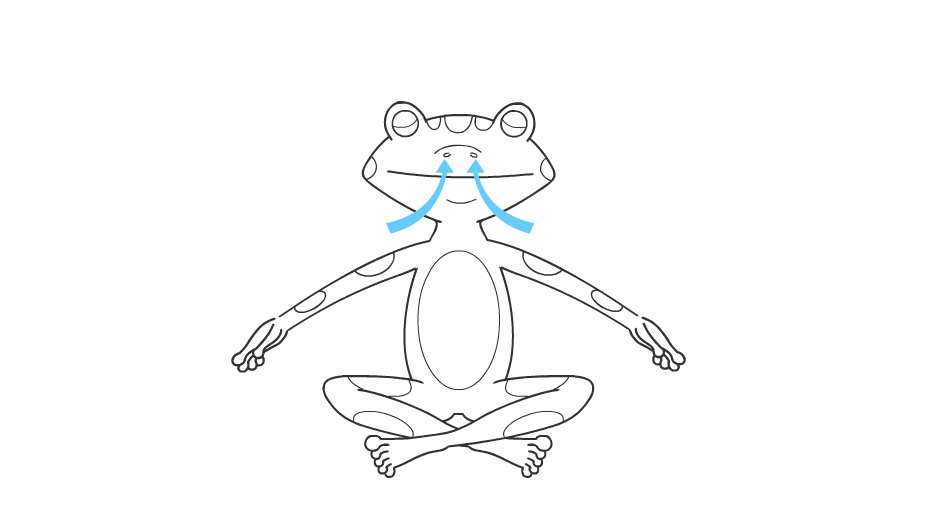

Once the first sequence was animated, Pure Edge wanted to have a visualization of the breath itself. First we tried arrows in a pale blue, but they were both distracting and not particularly clear. Wispy lines proved to be a more engaging and clear illustration of both inhales and exhales, how they pull in and flow out.
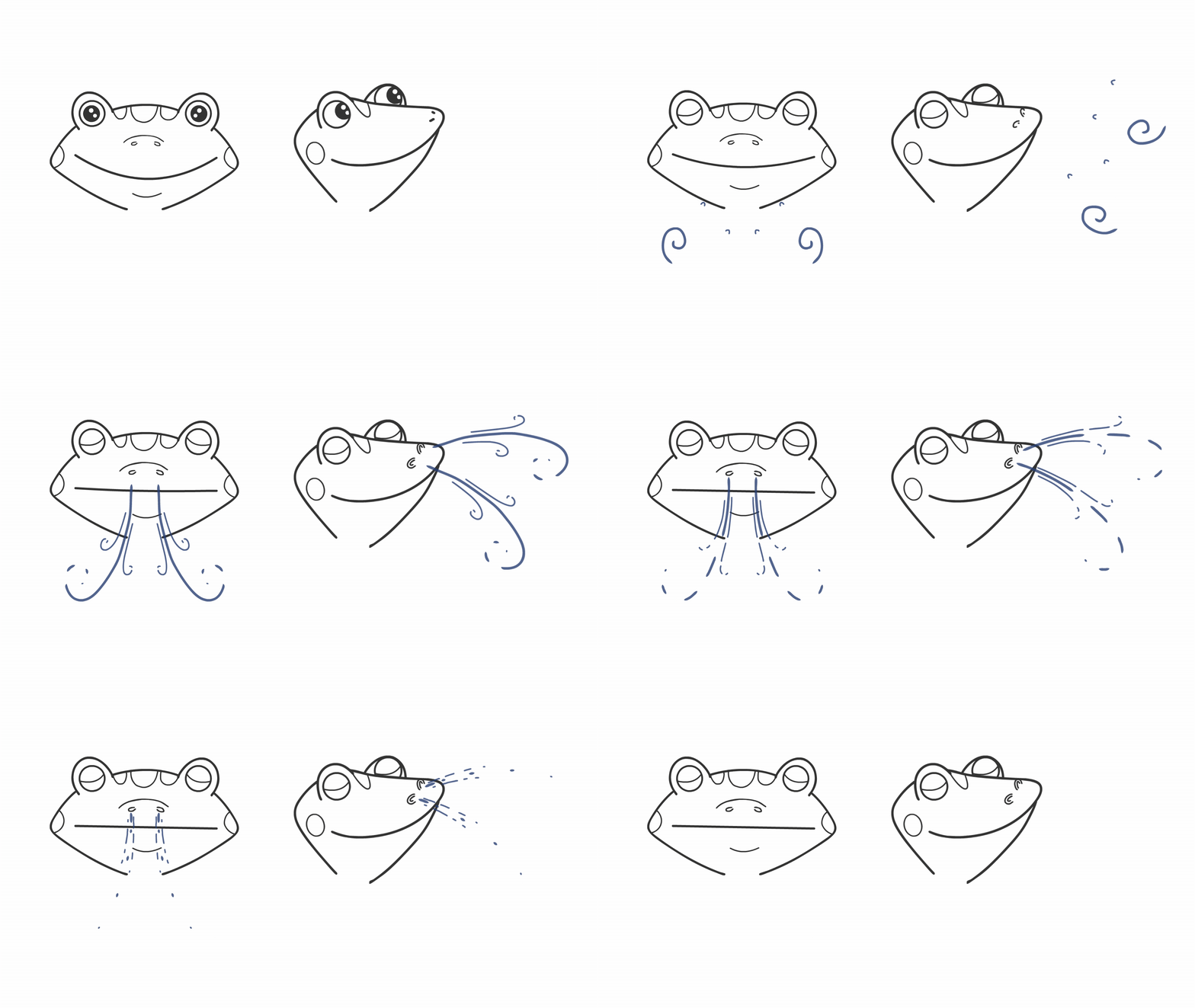
Once we got the shape/approach nailed down, we adjusted the color. The pale blue wasn't ideal when it came to readability, so we went for a darker approach, using the dark blue from the Pure Edge branding.
Because the dragon would breathe fire, I made their exhale a puff of smoke flowing from each nostril, which further differentiated their personality from that of the frog. Both characters are fully unique with different personalities.
Clip from Dragon doing Stork
Results:
The videos are currently being used as part of a curriculum to alleviate stress and to help calm overstimulated minds by focusing on three different areas: Breath, Movement and Rest. They are designed for classroom use, with the ability to be performed seated or standing, at desks or on the floor. They can be modified to meet the needs of the specific classrooms. They have been translated into several languages.
Update:
The program has been so successful in subsequent years that the curriculum has been scaled to make use of more complex yoga flows, and has expanded outside of classroom settings and are also used in children's hospitals and wards across the United States, see Movement Stories.
Clip from Breathing Buddy.